
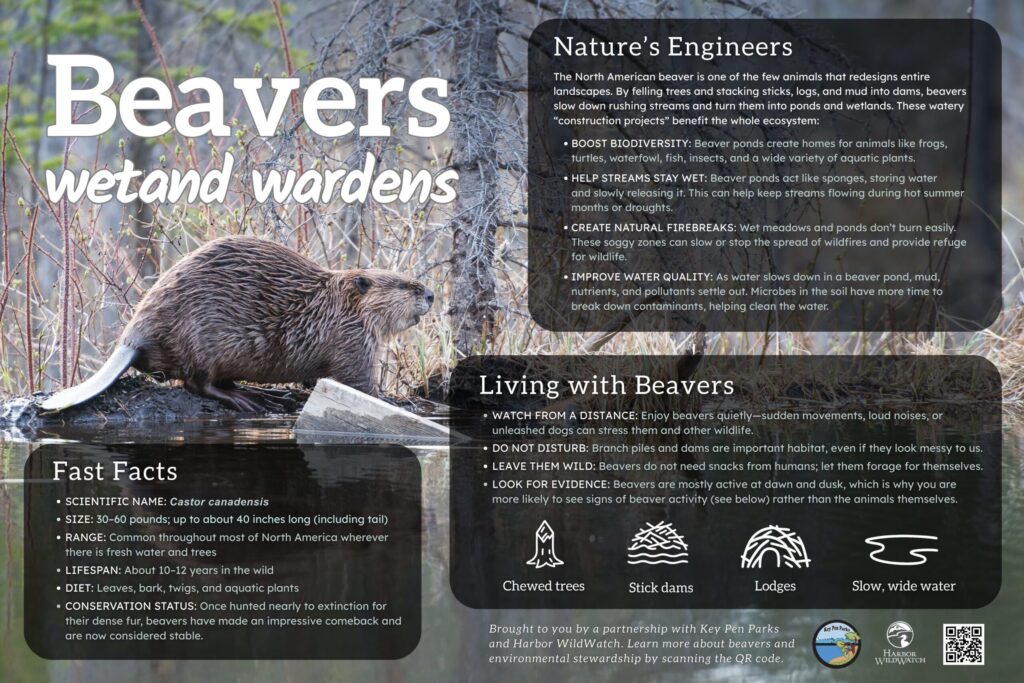
You’re at the Beaver Pond
What to Notice Right Now
Take 60 seconds and scan the scene like a wildlife biologist. You’re not just looking at a pond—you’re looking at a system that’s constantly being built, maintained, and reshaped.
1) Read the water first
Look for these quick clues:
- Water level line: A faint “bathtub ring” on grasses, sticks, or the shoreline shows where the pond recently sat.
- Still vs. moving water: Beavers prefer stability—if you see a calm pool here, it’s doing important work for the whole wetland.
- Inflow/outflow spots: Where water enters or exits, you’ll often see the most change (fresh mud, rearranged sticks, new channels).
2) Look at the edges
The shoreline tells the story of what’s happening this week:
- Fresh chips = recent activity. Bright, pale wood chips mean chewing happened recently.
- Smooth muddy slides: A “beaver runway” is often a subtle, slick path into the water.
- Newly placed sticks: If you see sticks that look intentionally woven or packed, you’re seeing active maintenance.
3) Decode the dam and lodge like architecture
If you can safely view the structure from a distance:
- Sticks crisscrossed + mud packed in = stability and water control.
- A messy look is normal. What looks chaotic to us is often a functioning design for slowing water and sealing leaks.
- One spot may look “newer.” Beavers often focus repairs where water pressure is strongest.
What the Pond Is Doing While You Watch
Even if you don’t see a beaver, the pond is busy:
- Catching sediment: Slower water lets mud and debris settle—this changes the pond over time.
- Creating habitat layers: Shallow edges, deeper pockets, and wet meadow zones are all different “rooms” for different species.
- Buffering dry spells: Stored water can help keep nearby areas wetter longer into the summer.
Seasonal Timeline: So You Can Guess What’s Next
You can often tell the season’s priorities by what you observe:
- Spring: Fresh plant growth; shoreline browsing; lots of movement in and out of water.
- Summer: More twilight activity; maintaining water levels becomes critical.
- Fall: Heavy construction season—expect more stick hauling and dam/lodge reinforcement.
- Winter: Less visible activity, but structures still matter; you may see subtle maintenance after storms.
Signs of Wildlife You Can Spot From This Exact Place
If you want a quick scavenger hunt, look for:
- Tracks at muddy edges: Webbed hind-foot prints can show near the waterline.
- Gnawed “pencil-point” stumps: Clean, angled cuts are classic.
- Feeding areas: Bits of bark, clipped stems, or stripped branches near the shore.
- Bird life: Waterfowl and songbirds often use these edges as feeding corridors.
Pro tip: If you stand still for 2–3 minutes, you’ll notice far more movement—especially birds and insects.
How to Be a Great Pond Visitor
A few choices make a big difference for wildlife and for other people’s experience:
- Pause, don’t pursue: If you spot movement, stop and watch—following wildlife pushes it away.
- Keep dogs close: Wildlife stress increases fast when dogs roam the shoreline.
- Stay on durable surfaces: The soft edges are habitat (and easily damaged).

Partnership Info: Harbor WildWatch + Key Pen Parks
This interpretive sign and QR landing page are part of a formal partnership between Harbor WildWatch and Key Pen Parks focused on community enrichment and environmental learning. Under the agreement, Harbor WildWatch produces interpretive signage and delivers educational programs within the district at no cost to Key Peninsula residents. Key Pen Parks supports this work through contracted funding, and Harbor WildWatch provides participation reporting after the conclusion of services.